Ball Valve
Choosing the Best Ball Valve Supplier in Malaysia: A Comprehensive Buyer’s Guide
In the heart of Malaysia’s booming industrial landscape—from the palm oil refineries of Klang to the offshore platforms in Terengganu—precision and reliability are non-negotiable. At the core of these operations lies a small but critical component: the ball valve.
Finding a trustworthy ball valve supplier in Malaysia is more than just a procurement task; it is an investment in operational safety and efficiency. In this guide, we explore why ball valves are the preferred choice for Malaysian industries and what you should look for in a supplier.
What is a Ball Valve and Why is it Essential?
A ball valve is a shut-off valve that controls the flow of a liquid or gas by means of a rotary ball with a bore. By rotating the ball 90 degrees around its axis, the medium can flow through or be blocked.
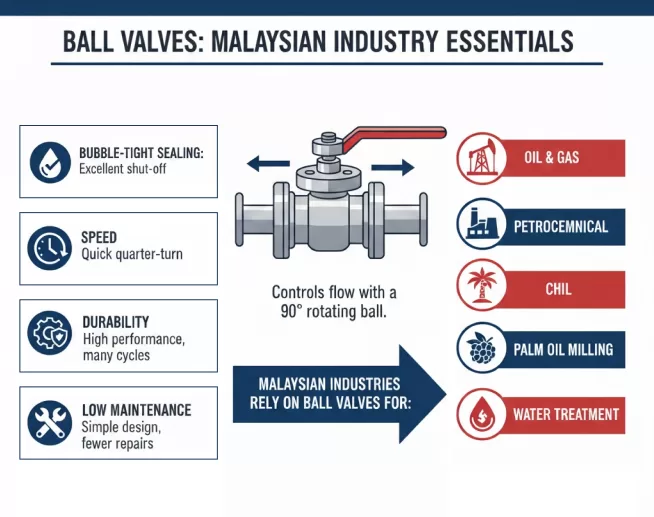
In Malaysia, industries like Oil & Gas, Petrochemical, Palm Oil Milling, and Water Treatment rely on ball valves because they offer:
- Bubble-tight sealing: Excellent shut-off capabilities.
- Speed: Quick quarter-turn operation.
- Durability: High performance even after many cycles.
- Low Maintenance: Simple design leads to fewer repairs.
Common Types of Ball Valves Available in Malaysia
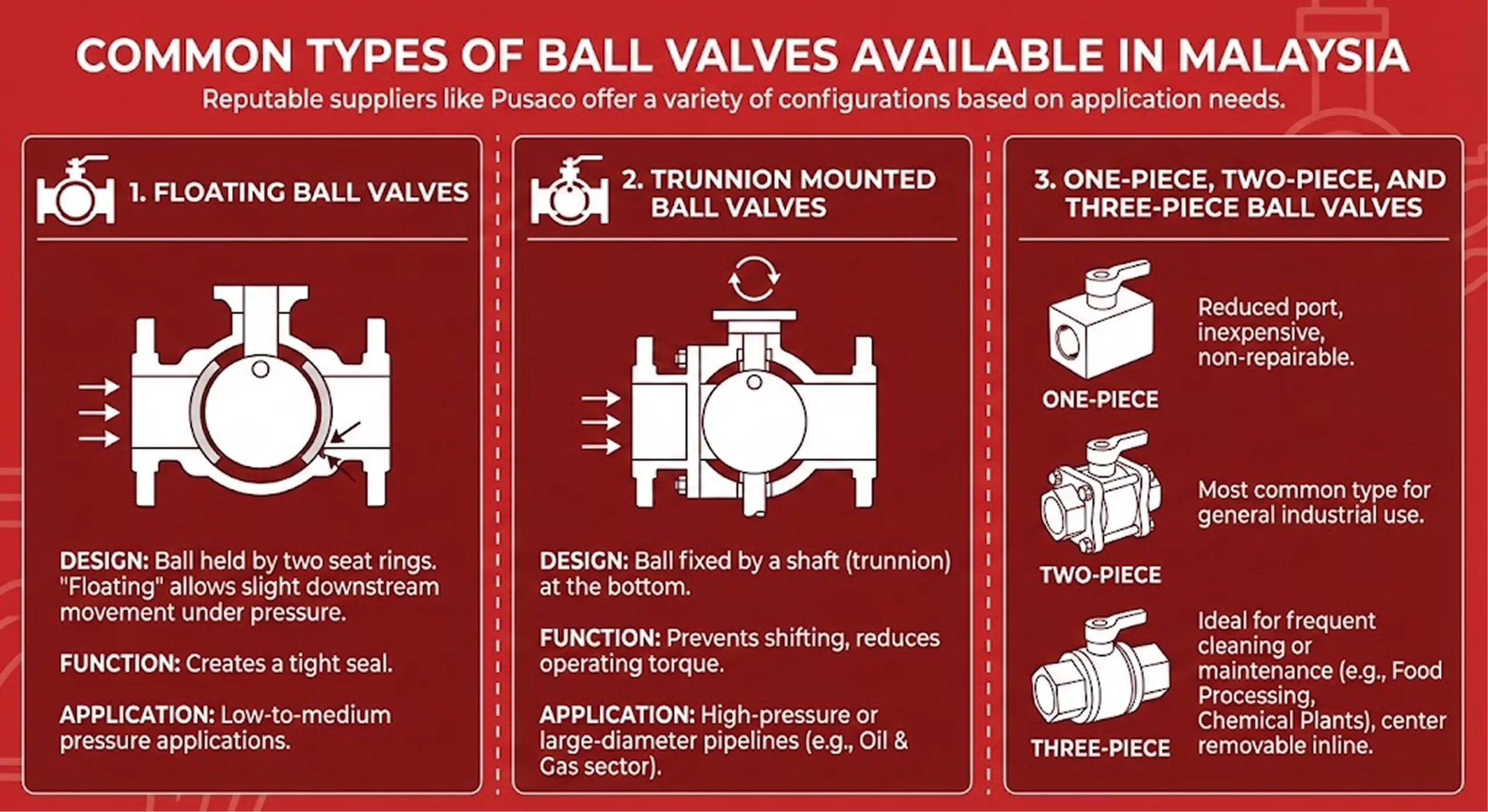
When searching for a ball valve supplier in Malaysia, it is important to know which specific type suits your application. Most reputable suppliers like Pusaco offer a variety of configurations:
In Malaysia, industries like Oil & Gas, Petrochemical, Palm Oil Milling, and Water Treatment rely on ball valves because they offer:
- Bubble-tight sealing: Excellent shut-off capabilities.
- Speed: Quick quarter-turn operation.
- Durability: High performance even after many cycles.
- Low Maintenance: Simple design leads to fewer repairs.
1. Floating Ball Valves
In this design, the ball is held by two seat rings. It is “floating” in the sense that it can move slightly downstream under pressure to create a tight seal. These are typically used for low-to-medium pressure applications.
2. Trunnion Mounted Ball Valves
For high-pressure or large-diameter pipelines (common in the Malaysian Oil & Gas sector), Trunnion valves are preferred. The ball is fixed by a shaft (trunnion) at the bottom, preventing the ball from shifting and reducing the torque required to operate the valve.
3. One-Piece, Two-Piece, and Three-Piece Ball Valves
- One-piece: Reduced port, inexpensive, and non-repairable.
- Two-piece: The most common type for general industrial use.
- Three-piece: Ideal for industries requiring frequent cleaning or maintenance (e.g., food processing or chemical plants) as the center section can be removed without disturbing the pipework.
Comparison Table: Floating vs. Trunnion Ball Valves
| Feature | Floating Ball Valve | Trunnion Mounted Ball Valve |
| Pressure Rating | Low to Medium | Medium to High |
| Size Range | Typically up to 10″ | Up to 60″ and above |
| Sealing Mechanism | Pressure pushes ball against seat | Seat is spring-loaded against the ball |
| Operating Torque | Higher at high pressure | Lower (More efficient) |
| Common Application | Water treatment, general HVAC | Oil & Gas, High-pressure pipelines |
Key Factors When Choosing a Reliable Ball Valve
Supplier
With many distributors in the market, how do you identify a top-tier supplier? Here are the essential criteria:
1. Industry Certifications and Standards
Quality assurance is paramount. Ensure your supplier provides valves that meet international standards such as:
- API 6D: Specifications for pipeline valves.
- API 607 / API 6FA: Fire-safe testing standards.
- ISO 9001: Quality management systems.
- SIRIM: Local Malaysian certification for specific industrial requirements.
2. Material Availability
Malaysia’s humid and corrosive environments (especially offshore) require specific materials. A good supplier should stock:
- Stainless Steel (SS316/SS304): For corrosion resistance.
- Carbon Steel (WCB/A105): For high-temperature/pressure services.
- Special Alloys: Like Duplex or Monel for aggressive chemical media.
3. Local Technical Support and Inventory
Nothing halts production like a long lead time. Choosing a ball valve supplier in Malaysia with a local warehouse ensures:
- Ready Stock: Faster delivery for urgent replacements.
- On-site Consultations: Technical experts can visit your plant to recommend the right valve specifications.
- After-sales Service: Local support for maintenance and spare parts.
4. Customization and Actuation
Modern industrial plants often require automated systems. Check if your supplier can provide Actuated Ball Valves (Pneumatic or Electric). At Pusaco, we provide complete valve automation solutions tailored to your control system requirements.
Frequently Asked Questions (FAQ)
How long do industrial ball valves typically last?
With proper selection and periodic maintenance, a high-quality ball valve can last 8 to 10 years or more, depending on the cycle frequency and the medium being transported.
Can ball valves be used for throttling flow?
Generally, no. Ball valves are designed for “on/off” service. Using them for throttling can damage the seats and the ball over time due to high-velocity flow.
What is the most common ball valve material used in Malaysia?
For general industrial and water applications, Stainless Steel (SS316) is highly popular due to its resistance to rust in Malaysia’s tropical climate. For the Oil & Gas sector, Carbon Steel (A216 WCB) is the standard.
Conclusion
Selecting the right ball valve supplier in Malaysia is critical for the safety and longevity of your industrial infrastructure. By focusing on quality standards, material suitability, and local support, you can ensure your operations run smoothly with minimal downtime
Ready to upgrade your flow control systems?
Contact Pusaco Industrial Supplies today for a consultation or a competitive quote on our range of high-performance ball valves.