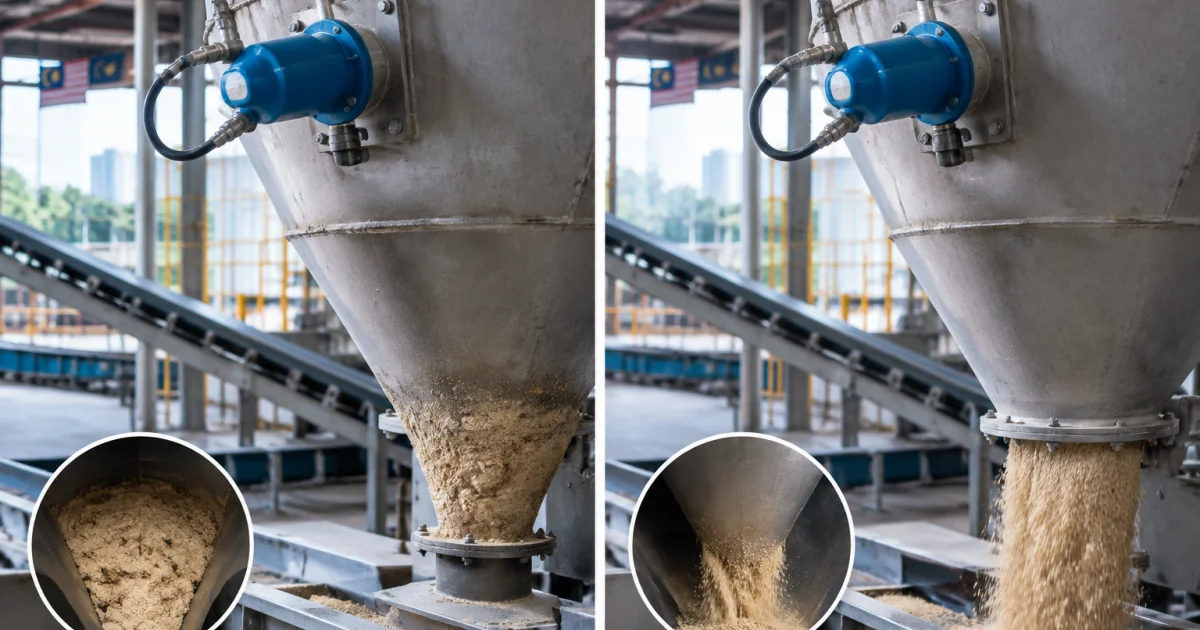
Why Exen Air Knockers Beat Manual Hammering for Solving Silo Bridging and Hopper Blockage
In feed mills, flour mills, fertilizer plants, and other bulk-material operations, bridging and hopper blockage rarely arrive with warning. One shift runs normally; the next, a chute starves downstream equipment and someone reaches for a hammer “just to get it moving again.” It’s familiar, immediate, and seems cheap.
But manual hammering is often one of the most expensive “free” habits in a plant. It pulls labour at the worst time, encourages risky work around bins and chutes, and delivers inconsistent force—when consistent intervention is what flow problems respond to best. For many sites, a pneumatic air knocker is the more professional answer because it turns an emergency workaround into a controlled, repeatable flow-aid method.
This article explains why the Exen Air Knocker often outperforms manual hammering for solving silo bridging and hopper blockage—especially for engineering and maintenance teams who want fewer stoppages, more predictable discharge, and safer interventions.
Why manual hammering “works”… until it doesn’t
Let’s separate fact from opinion. Fact: striking a hopper wall can break a fragile bridge, detach adhered material, or collapse a rat-hole. The problem is that it “works” mainly because it’s immediate, not because it’s a stable process solution.
Manual hammering has built-in weaknesses that show up as uptime expectations rise:
- Uncontrolled energy: impact varies by person, fatigue, and urgency.
- Wrong location: people hit what they can reach, not necessarily the best point on the cone, transition, or bin wall.
- Late response: the hammer comes out after flow has already degraded and equipment is being starved.
- Repeat cycle: relying on hammering trains the operation to accept stoppages as normal.
There’s also a maintenance angle. Repeated impacts can contribute to paint failure, wall deformation at thin sections, loosening of external fixtures, and vibration-related issues around instruments or supports. Not every strike causes damage, but making hammering routine is a reliability strategy built on variability.
How pneumatic air knockers solve bridging more predictably
An air knocker is part of industrial flow aid equipment—devices intended to reduce adhesion, prevent bridging, and keep material moving with less human intervention. The practical advantage of a pneumatic knocker is repeatable impact at a defined location, with controllable timing.
In plant terms: compressed air drives an internal piston/hammer that strikes an anvil or body, transmitting a shock through the hopper wall. That impulse can break cohesive arches, dislodge stuck product, and reduce stagnant zones—especially when applied early and periodically rather than as a last resort.
Why does that matter? Many bridging events start small: an adhered layer becomes a ledge, the ledge becomes a shelf, then a full bridge forms. A controlled knock at the right interval can interrupt that progression before production feels it.
Control is the real upgrade
What you’re buying with a pneumatic solution isn’t only “more force.” You’re buying control:
- Timing control (manual, automatic, or tied to process signals in some designs)
- Impact consistency stroke after stroke
- Repeatable installation location aligned to known problem zones
- Integration with plant pneumatics, air preparation, fittings, tubing, and solenoid valves
That turns an unpredictable human workaround into an engineered, repeatable method.
Why Exen air knockers often beat “bigger hammers” in real plants
Site specifics matter, but there are common reasons maintenance teams prefer Exen-style pneumatic knockers over manual intervention once they’ve lived with both.
1) Reduced safety exposure and fewer risky interventions
Approaching a bin, hopper, or chute to strike it creates exposure: awkward posture, noise, pinch points, work at height, and the temptation to get too close to moving equipment to “clear it quickly.” With an installed knocker, actuation can be done from a safer position, while maintenance shifts from emergency clearing to planned checks.
A knocker doesn’t replace safe-work procedures; it reduces how often urgent hands-on intervention is needed.
2) Better consistency equals better downstream stability
When discharge fluctuates, downstream systems suffer: feeders surge, bagging becomes inconsistent, and pneumatic conveying lines can plug. Cycling between “stuck” and “avalanche” stresses equipment and triggers nuisance stops and alarms.
Used proactively, a knocker can help maintain steadier discharge (or at least reduce extreme interruptions), improving overall line stability and reducing avoidable flow collapses.
3) Installation is a one-time engineering decision, not a repeated habit
Hammering is an operational habit you repeat forever. A knocker is an engineering decision you make once and then refine. That distinction forces useful questions: Where is the true bridging zone? How does the material behave? What air quality do we have? What actuation strategy fits our duty cycle?
Those answers often improve bulk-handling reliability beyond the knocker itself.
4) It fits into a broader pneumatic and automation ecosystem
Most plants already support pneumatic infrastructure—air lines, FRL units, and valve islands. Air knockers fit that ecosystem cleanly. Where appropriate, you can use established pneumatic components (including commonly specified brands such as Festo) for actuation and control, provided the design meets your duty cycle and safety requirements.
The key point: a knocker can be engineered like any other pneumatic function—sized, protected, and maintained—not improvised with a tool.
Practical selection and installation guidance (what to verify before buying)
Bridging is rarely “one cause.” It can involve cohesion, moisture, fines, electrostatic behaviour, poor hopper geometry, or a combination. An air knocker can be effective, but only if it’s matched to the real problem. Use this checklist for an engineering evaluation.
Understand your material behaviour first
Material properties drive impact frequency, placement, and whether a different approach is needed (vibrator, aeration, liners, or redesign). Before selecting hardware, document:
- Material type and variability (seasonal, supplier, or formulation changes)
- Typical moisture range and whether condensation occurs
- Particle size distribution and fines content
- When bridging occurs (after long static periods, during high throughput, after washdowns)
This is not lab-level rheology; it’s a practical operating profile that helps you choose a firing strategy that targets the real trigger.
Confirm mounting points and structural suitability
Knockers must be mounted where impact transmits into the problematic zone. Check:
- Wall thickness and reinforcement ribs
- Maintenance access without unnecessary work at height
- Distance to sensitive devices (level switches, load cells, instrumentation impulse lines)
- Whether large vessels need multiple units on the cone/transition
If you’re replacing hammering, map where operators currently strike and compare it to where bridging actually forms. Those locations often differ.
Plan the air supply and control components like a real system
Air quality and control directly affect consistency. Poorly prepared air can lead to sticky valves or irregular striking. Plan appropriate air preparation, sensible line sizing, and isolation so maintenance can work without shutting down unrelated pneumatics.
If a solenoid valve triggers the knocker, ensure it matches the duty cycle and environment so you avoid over-cycling or unreliable actuation.
Don’t forget the interfaces: valves, conveying, and flow paths
Many blockages are “diagnosed” at the hopper while the root cause is elsewhere: a partially closed slide gate, a sticky rotary valve, a worn diverter, or an upstream surge that compacts product. While addressing bridging, inspect the full flow path—especially any ball valves used for utilities, purge air, or ancillary lines that influence air injection, dust extraction, or cleaning routines.
This prevents buying hardware to compensate for a simple restriction or control issue.
Where manual hammering still has a place (and where it shouldn’t)
Manual intervention can still be useful during commissioning or troubleshooting. A controlled “tap test” may help confirm where a bridge is forming or whether build-up is present.
However, if hammering becomes part of daily routine, it’s a signal that the process needs a better tool. A practical line to draw:
- Acceptable: occasional diagnostic tapping during controlled maintenance activities.
- Not acceptable as normal operations: repeated hammering to keep production running, especially when it pulls labour from planned work and exposes people to hazardous areas.
Upgrading to an air knocker doesn’t just address bridging; it supports a better operating culture: fewer emergencies, more standardisation, and clearer accountability for flow reliability.
Conclusion: a knocker is a reliability decision, not just a gadget
Manual hammering is the bulk-handling equivalent of resetting a tripped breaker without investigating the overload: you may get the line moving, but you normalise disruption. For bridging and hopper blockage, a pneumatic knocker is usually a smarter investment because it provides consistent, repeatable impact where and when it’s needed, while reducing risky interventions.
If your plant is evaluating flow-aid upgrades, treat hopper and silo discharge as a system: understand material behaviour, identify the true bridging zone, and specify a knocker and pneumatic control approach that matches operating reality. Done properly, an Exen Air Knocker is not just a replacement for a hammer—it’s a step toward predictable flow and better uptime.
For related reading and product context, you may find these resources helpful: How Pneumatic Knockers Prevent Blockage In Bulk Material Handling and The Efficiency Of Exen Flow Aid System In Industrial Processes.
Frequently Asked Questions
How do air knockers prevent silo bridging and hopper blockage?
Air knockers deliver a short, repeatable shock to the silo or hopper wall that helps break forming arches, detach adhered material, and collapse rat-holes. When applied proactively (not only after a full blockage), the impact interrupts build-up patterns before flow stops and downstream equipment is starved.
What material types benefit most from pneumatic knockers?
Plants typically see the biggest benefit on cohesive or variable bulk solids that tend to stick, compact, or form stable bridges—especially when moisture, fines, temperature changes, or long static holding times are involved. The key is matching the knocker placement and firing strategy to the material’s real flow behaviour rather than relying on occasional heavy impacts.
What should I check before installing an Exen air knocker on a hopper?
Confirm where bridging actually forms, verify the wall thickness and reinforcement at the intended mounting point, and ensure safe maintenance access. Then review the compressed-air supply (air preparation, line sizing, isolation) and select suitable actuation components (such as a properly rated solenoid valve) to achieve consistent strikes without over-cycling.
Can an air knocker be integrated with existing pneumatics and automation brands like Festo?
Yes—many sites integrate knockers into existing pneumatic infrastructure using common air preparation units, fittings, tubing, and control valves. Compatibility depends on proper sizing, duty cycle, air quality, and the control method you choose. Your maintenance team should treat it like any other pneumatic function: engineered, protected, and documented.
Is manual hammering ever acceptable as a long-term solution?
Manual hammering can be useful for occasional diagnostics during controlled maintenance, but it is rarely a good long-term operating method. As a routine practice, it increases safety exposure, creates inconsistent impact, and tends to respond only after the process is already disrupted—whereas installed flow-aid equipment is designed to deliver consistent, repeatable intervention.
Reduce bridging without risky hammering—talk to Pusaco
Pusaco Industrial Supplies Sdn. Bhd. supports bulk-material plants with flow-aid solutions such as air knockers, pneumatic components, and engineering guidance to help stabilise discharge and reduce unplanned stoppages. If you’re evaluating an Exen setup (or troubleshooting recurring hopper blockage), our technical sales engineers can help you review material behaviour, mounting points, and pneumatic control requirements.